
Courage is being afraid but being strong enough and resourceful enough to do it anyway.
I see it in senior women and men who know what they want to say… but wait. Who know the direction they need to take… but pause. Who delay the conversation that needs to be had… but avoid the interaction.
It’s all about refusing to let doubt make decisions on your behalf. It is about having the confidence in your thoughts and ideas.
Having the courage to speak isn’t easy but it’s the moment you stop feeling uncertain, start feeling your presence and value.
How long do we have to wait for stuff to be certain. In business nothing is ever 100% sure. But we often wait for clarity before we act.
And if you remain silent, what are you consenting to?
The moment you commit and open your mouth – not perfectly, not loudly, just honestly – something shifts in you and in the room.
If you’re standing on a threshold today, ask yourself: What small act of boldness would change the energy of the moment?
Sometimes no decision is worse than a bad decision.
Sometimes the magic is in the decision to stop waiting.
Posts and Provocations
-
courage is acknowledging the fear but doing it anyway
-
do you use your voice?
Madeleine Albright:
“It took me quite a long time to develop a voice, and now that I have it, I am not going to lose it.”You have a voice. Are you actually using it?
The senior women and men I work with often obsess over what to say, but almost never think about how it is said.
How does it land? What is the impact and outcome are you striving for?
Linguistic style – your default way of speaking – is the way that shapes how people experience you:
Do you speak with clarity or do you hedge?
Do you pause with intention or ramble to fill space?
Do you choose words that land… or words that dilute or confuse?
Do you use humour, metaphor, story – or do you use corporate-bingo speak?Your voice is already telling people who you are – whether you meant it to or not. So how are you going to use it?
Because your voice determines:
Whether people trust you
Whether they follow you
Whether they feel safe speaking up around you
Whether your ideas light a spark or chuck a bucket of cold waterSo if you’ve worked hard to develop your voice, don’t just “use” it.
Use it boldly.
Use it with intention and purpose.
Use it in a way that makes people sit up and take notice.Otherwise, what was the point of finding it?
How are you using your voice – really? -
I’m not a bookie but….but even I know, if you don’t try, there’s a 100% chance it won’t happen.
Easy to forget that sometimes.
It’s that niggling voice that says – what makes you think you can do that.
That voice that sits somewhere at the back of the head, sneering from the sidelines.
Guess what? Time to put it is its rightful box and kick it into the stratosphere where it belongs.
This has nothing to do with capability, authenticity or expertise.
But here is what it is about….
Trying is already an act of courage.
It’s choosing possibility over the safety of staying in the status quo.
It’s you backing yourself, even if your confidence hasn’t fully arrived yet.
You don’t need certainty to begin. You just need to give yourself a chance maybe a nudge.
Leaders don’t move forward because they’re fearless.
They move because they refuse to let inaction define the outcome.
Trying is all about trusting yourself. Speaking up is about being present.
I would love to hear your story when you felt like this, and still you screwed up your courage to give it a go.
Go on- you’ve got this.
-
I don’t often quote Confucius, in fact I have never quoted the Chinese philosopher before, but this seemed appropriate;
“To see what is right and not do it is the want of courage.” – Confucius
What holds senior leaders, women and men, back in organisations?
A lack of skill, ambition, or readiness? No, they’re held back by systems that benefit from them staying in the current position. Well guess what – work life is not a meritocracy.
Let’s be honest does this sound at all familiar?
Many workplaces run on the unpaid labour of people’s work diplomacy, the stuff that greases the wheels of business, quiet communications and behind‑the‑scenes leadership and fix-it mentality. It’s efficient – until those same people decide they have done enough and something must change.
They see the gaps in decision‑making. They see the politics that reward visibility over value. They see the double standards that expect them to be endlessly competent but selectively courageous.
And I believe we also see this:
Staying silent serves the system, not their leadership.
Seeing what is right but not having the courage to name it.
Leadership at this level, in this context requires courage:
- Challenging the norms that keep them in the “supporting role”
- Taking strategic risks instead of being the safe pair of hands and being known for that
- Choosing ambition without apology or justification. Their career is theirs.
This isn’t about being difficult.
It’s not about being labelled as aggressive.
It’s about being done with systems that rely on compliance.
It maybe not being liked- you have your family and friends for that.
Because many senior people already know what is right.
The real shift happens when they stop protecting the system – and start protecting their future and speaking up for that.
You’ve got this.
-
What are you silently agreeing to if you don’t speak up?
💫 “Ask for what you want and be prepared to get it.” — Maya Angelou
We learn to navigate systems not built with us in mind.
To make space, even when it’s not given.
So what do you want next?
More impact? More clarity? More space to lead on your terms?It takes more than courage—it takes clarity, timing, and a willingness to be seen and heard. Here’s what the research and coaching wisdom suggest:
🔍 What it takes to ask for what you want at work:
- Clarity of desire
Know what you’re asking for and why it matters. Is it about impact, balance, recognition, or growth? The clearer you are, the easier it is to communicate. - Emotional readiness
Asking isn’t just about words—it’s about being prepared for the response. That includes hearing “no,” negotiating, or even being surprised by a “yes.” - Strategic timing
Choose moments when your contribution is visible, when trust is high, or when the organisation is open to change. A well-timed ask lands better than a rushed one. - A sense of consequence
Not asking has a cost. It can mean staying silent while others shape your path.
Not speaking up is still a choice.
It’s a quiet yes.
To staying small.
To letting others define the terms.
To accepting consequences we didn’t choose.In coaching, I ask:
👉 “If you say yes to this, what are you saying no to?”
But sometimes, the real question is:
👉 “If you don’t speak up, what are you silently agreeing to?”Leadership isn’t just about being heard.
It’s about choosing to be heard—especially when it’s uncomfortable.💬 What’s your silence costing you?
- Clarity of desire
-
Are you being present or do you have presence?
This is not semantics.
Having presence is not the same as being present.
You can be in the room and still not show up.
You can speak and still not be heard.
You can lead and still don’t have the impact you want.
I see it often—leaders navigating change, transitions, new chapters. They’re visible, yes, but something’s missing. The spark. The conviction. The why. Their presence.
Presence isn’t about being busy or booked.
It’s about being intentional.
It’s about showing up with your values intact.
Some things I ask in coaching conversations:
• What are you holding back that needs to be said?
- Where are you showing up out of habit, not purpose?
• What would shift if you led from alignment, not obligation?
- What do you need to do today that if you don’t do it, you will regret it in 6 months?
Leadership isn’t about noise.
It’s about clarity.
And sometimes, the quietest voice is the one that changes everything.
-
Self reflection; article by Stephen Fleming, University College. London
This is thought provoking;
By boosting self awareness in our daily lives we might notice things we haven’t noticed before in ourselves, in others and in our surroundings. These changes may permeate many aspects of our lives, because being self aware is central to how we experience the world, The kind of consciousness we cherish- the kind that allows us to appreciate the smell of coffee, reflect on the beauty of a sunset- involves ‘meta awareness ‘, a state of knowing that we are conscious.
-
Bologna and Cobalt Red
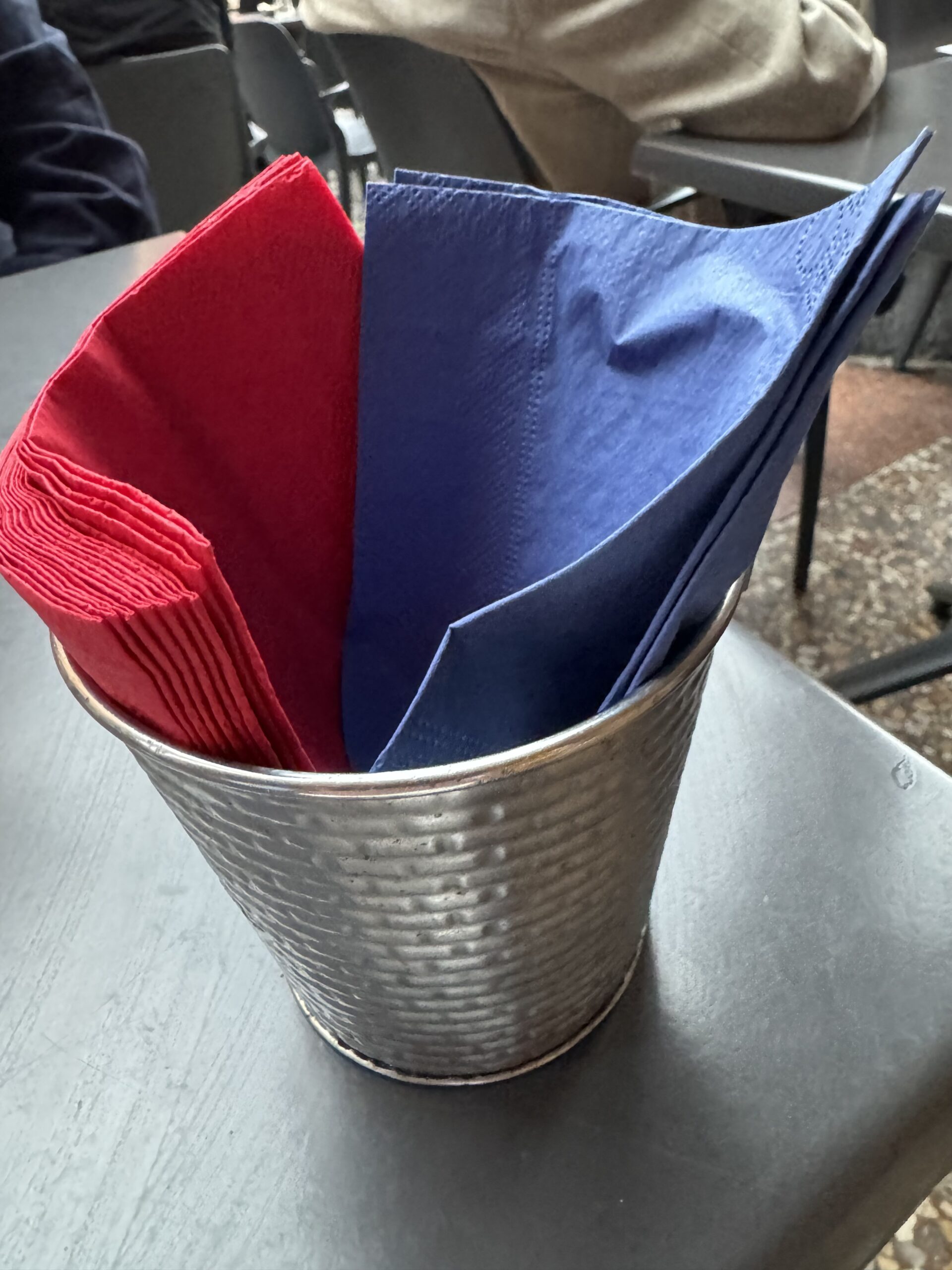
Another glorious month in Bologna, living and speaking Italian. On our arrival hundreds of Bolognese were sporting blue and red colours. Their team had just reached the Champions leagues for the first time in 62 years. Know I loved the city especially when I saw cobalt blue and red napkins nestled together!
-
50 clients and still going!
When I set up my coaching business, Cobalt Red, just under 5 years ago, I decided that 20% of my work would be offered on a pro bono basis.
I am delighted to announce that I have now coached over 50 pro bono clients from more than 12 African countries all of whom are the alumni of the African Leadership Academy (ALA). This seminal organisation takes the crème de la crème of young people from across the African continent. They are supported to complete their first degree, then often move on to Oxford, Harvard, Stanford and other prestigious universities for a second degree- be that a PhD or MBA.
They are undoubtedly the leaders and entrepreneurs of tomorrow and the coaching partnership I create with them is the catalyst for so much more.
The experience is one which is challenging, rewarding and sometimes humbling-and I wouldn’t have missed it for the world.
My thanks go to my clients, some of whom are listed below and those at ALA who helped to have it happen. -
One Day
Have you read One Day by David Nicholls or perhaps you are watching the Netflix series?
is it ONE DAY
or
DAY ONE
and if it is not Day One
to what are you saying yes?
what is stopping you?
how are you going to address the obstacles you see and feel?
how important is this to you?
It is all about provoking disruption – which is how I describe my coaching style.